It's a hike...
turning teenagers towards books

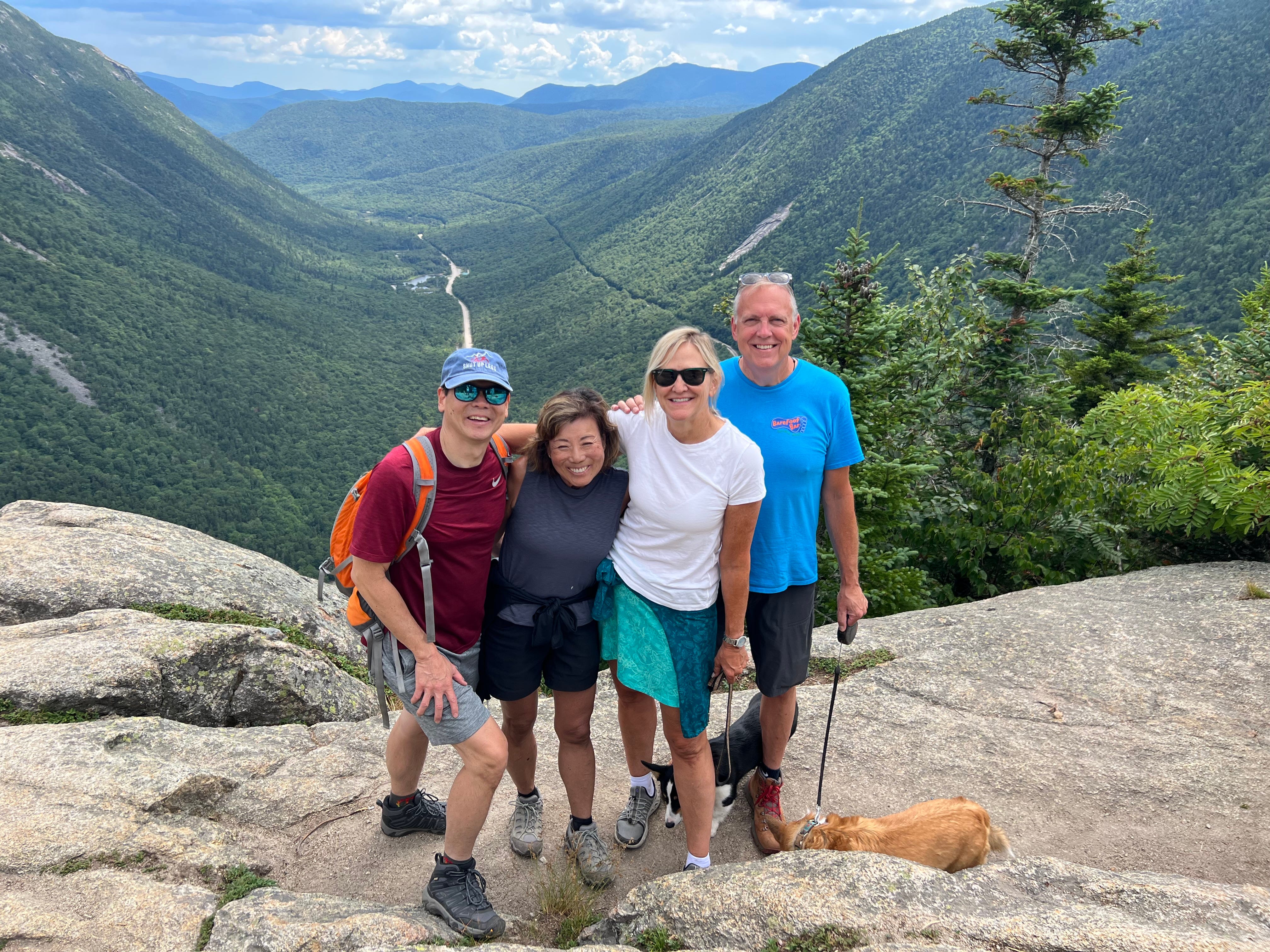
For the last 30 years, I have lived in New Hampshire, minutes from the Presidential Range and other wandering routes in the White Mountains.
Our garage is stuffed with trail shoes and snowshoes. We hike all year. Backpacks are crowded by first aid kits, binoculars, water bottles, and snack boxes.
My husband carries the White Mountain Trail Guide. We plan thoroughly because uncertainty lurks on every trail. Clouds obscure the path ahead or might drop in and camouflage a familiar landscape in seconds. A leap, wet rock to wet rock across a stream, could twist an ankle. Has.
There are glorious vistas in the White Mountains. When we reach a summit, we sit in awe. Birds call. Our Corgis slurp water, find a spot of shade, and pant. We stretch our weary limbs. The wind shifts beside us, lifting fallen leaves. A spray of clouds drifts by. Our breathing slows.
The summit matters as much, or more, than the climb.
The trail guide is essential, of course. There are many ways to get to the top. But navigation is equally important. Maps can’t show all the obstacles: simple ones like a fallen tree that blocks our ascent after a storm, or a slippery, washed-out section with no firm footing. Both require on-the-spot problem solving. Sometimes we reroute. Sometimes we retreat. We accept that there are days when our expectations aren’t met. We turn back. No one likes to fail, and we growl on our descent. But the summits invite us, and soon we return.
Last spring I sat down during an intensely difficult section of a relatively short hike and cried. I was far behind my husband and daughter. I kept slipping in mud. My lungs had shrunk. My breaths, shallow. I couldn’t see the top. I couldn’t yell. The trees leaned in. I froze.
What I was carrying was invisible yet intense. Inescapable. My friend had been dying for months, but on this day, it crushed me. I couldn’t move. In The Power of Moments: Why Certain Experiences Have Extraordinary Impact, authors Chip Heath and Dean Heath explore why certain experiences “jolt us and elevate us and change us.” That moment on the trail jolted me. As usual, I started thinking about teaching.
Hiking has an unpredictable nature. (Hikers, even more so.) And it is a bit like the teaching of readers. We are given curriculum maps. We have timelines. But we’ve also been given dozens of young people to guide from fall until summer. Some days they sprint ahead, and other days they arrive with invisible burdens that hold them back.
They are spread apart by both their will and skill. But instead of navigational tools to manage the predictable challenge of leading so many young readers at once, we’re told to keep marching. Stay on pace.
Some leaders avoid the hardest question: what conditions help a teacher differentiate instruction to strengthen both will and skill in a room full of young people? In a rush to keep going, we forget the destination. Our compass must point north. True North. To me, True North is a lasting, lifelong engagement with reading. If we lose track of that summit, we will get lost in the difficulty of the climb.
In my 41 years of teaching, I’ve seen teenagers who read a lot. I’ve met plenty who refuse. I’ve sat beside teachers who are determined to create lifelong readers, but the students are spread so far apart on that route that it feels impossible. I’ve created curriculum maps with colleagues and revised those given to them by publishers. I’ve learned to make use of the edge zones in a school day: hallway conferences, lunch breaks with book clubs, designing a school-wide reading break to replace homeroom. I’ve learned how and when to compromise.
And I’ve still failed to move every student in a class. (I hate that part.) I want every kid to find books that make them feel alive. To find characters they recognize and others that surprise them. I want students to persist with a challenging book. I want students to read and write and think about novels and nonfiction that shifts their understanding of others. I want students to discover reading’s undeniable power and never let it out of sight.
True North—a life of reading books—is still possible. But pretending to read starts early, and it becomes a habit. Performing as readers (without reading) started long before A.I. made it so easy. Wide reading impacts vocabulary and stamina and fluency, and most of all, confidence. It begins when we let kids, as Cooper says in the interview below, go at their own pace. Just like on a hike. If you doubt that, listen to seven minutes with three boys I taught in 12th grade years ago.
I will stuff my backpack with hope again this fall, determined to lead a wide range of kids to a reading life as individual as they are. It is always worth the climb.